Archive

That’s A Wrap! Highlights and Insights from BETT26

Picture of Michael Conlon

Michael Conlon

Former teacher, school leader, and survivor of many education reforms. Now an Education Transformation Consultant, Michael specialises in turning big tech promises into actual classroom wins.

Reflecting on BETT 2026, what emerged, beyond the multiple pieces of hardware and software that do more or less do the same thing, was a much calmer sense of direction to last year when AI was being plastered over every stand and without any sense of purpose. More specifically at XMA we could sense the following.


The value of community: We’re always fond of saying “Devices don’t teach children. Teachers teach children”, and so BETT is a place for people to connect, to share ideas and progress, inspire and influence each other in ways which are authentic and important and stripped of the hype. Teachers and leaders spent purposeful time exploring what is in the market and connecting with vendors who are looking to add value rather than just deliver transactional technology. At XMA we had endless conversations around the present and future of learning and teaching and how our solutions and capabilities support a digital strategy, from devices to deployment, thinking about the “Why” and less about the “What”. We ended Day 2 with marvellous dinner with our key customers, allowing them to network and build a community of their own.

We found it hugely impactful to have some of our customers deliver talks in our mini theatre and reminded us that they are often our best champions, talking out the value of our partnership and how XMA deliver solutions that really support their needs and ambitions and gave us the opportunity to expose to other potential customers the breadth of our capability.


Human centred AI: AI was an inevitable focus for attendees, speakers and vendors but this year there was a more thoughtful, grounded approach. We really began to get down into the weeds of how AI actually supports teaching and learning, be it from Microsoft or Google, or embedded in apps like Canva, Kahoot, Adobe and Thinglink, to mention just a few. This is an important step and customers were beginning to challenge the value that some of them bring. Professor Hannah Fry and Amol Rajan explore the ethics of AI in their Keynote, very much reflecting our approach in XMA that AI must retain that human connection that support pedagogical principles. There are issues like misogyny and bias that schools need to tackle through Digital Literacy programs and be assured that what they are putting in front of teachers and pupils is part of a framework that has guardrails and can evolve over time.


Esports: Esports made its presence felt again, with schools beginning to value gaming as a legitimate way of introducing digital skills and Team benefits. They’re understanding the potential of how Esports help explore things like event management, broadcasting, team leadership and nutrition, a very credible cross-curricular dynamic. New qualifications are starting to cement this understanding and standards and frameworks are being built to ensure this is not just a flash in the pan.


On-device AI: Terms like NPU (neural processing units)  and TOPS (Trillion operations per second) are beginning to become more familiar with customers as they begin to get to grips with the idea of AI work being done on device rather than in the cloud, and what speed and sustainability advantages a device with these kinds of chips will have. Vendors like Microsoft are building platforms that take advantage of this, allowing teachers the ability to build AI tool that support learning and teaching aligned to the educational standards in your country.

There was a good mix of smaller vendors, table top stands and technology-adjacent, many of whom we’re confident will grow and grow until their stands are prominent in the main floor. There is always almost too much on show at BETT and for many of our new attendees they felt it quite overwhelming at first. Despite being a veteran I still get blinded by the dozens of screen manufacturers and little STEM robot solutions that there are – an almost too crowded market in some respects, Dozens of talks and presentations, vendors and software, the show is at it’s best when people can navigate it through their field of interest and plan their day with comfortable shoes!


Finally, some solutions really come to life when you see children using them – that is often a clue in terms of how engaging the technology is and a reminder that we teachers work in service of these children’s future, so we should value what they tell us. I’d have a purely school children day but I realise that for some, many hundreds of kids in that space would be too much!

New White Paper: How Esports Facilities Impact University Recruitment and Student Success

The UK higher education sector is in a period of intense competition. To secure the best talent, institutions must offer facilities that deliver a tangible return on investment. For years, esports labs were viewed by many observers as expensive recreational add-ons. 

That view is now obsolete. 

A new survey conducted by XMA in partnership with Logitech provides the hard data to correct the record. We surveyed 1,000 current and prospective university students to separate anecdote from fact. The results are conclusive: advanced computing facilities are directly correlated to a university’s ability to attract students, support their wellbeing, and prepare them for the modern workplace. 

Here is the reality of the student demand. 

A Deciding Factor in Recruitment 

For the majority of prospective students, a university’s digital infrastructure is a primary litmus test for the institution’s quality. 

The report reveals that 60% of respondents state that the presence of dedicated gaming facilities would encourage them to choose a specific university. Perhaps more importantly for risk-averse administrators, only 1.5% said it would discourage them. 

The rhetoric that gaming distracts from serious study holds no weight with the students themselves. Instead, a well-equipped lab signals that the university understands the technology and culture that defines their generation. It converts an IT investment directly into a recruitment asset. 


The Demographic Reality Check 

University administrators often view “gamers” as a niche male demographic. The data dismantles this stereotype entirely. 

88% of students surveyed play games at least once a week, with 50% playing daily. Furthermore, this is not a gender-specific activity. While 93% of male respondents play weekly, a massive 85% of female respondents do the same. 

Investing in esports and advanced computing does not serve a minority interest, it serves the vast majority of your student intake. If you ignore this demographic, you ignore nearly 9 out of 10 students walking onto your campus. 


More Than Just Gameplay: The Academic Link 

Students view these facilities as practical learning environments, not just arcades. They see a direct line between high-spec hardware and their professional futures. 

  • Career Preparation: 83.4% of students say that access to emerging technologies (like AI, VR, and high-spec computing) is important for their future careers. 
  • Skill Transfer: Students explicitly associate these facilities with developing marketable skills in game design (72%), programming (54%), and digital content creation (49%). 
  • Course Selection: 44% of respondents stated that access to gaming facilities would make them more likely to choose a technology-focused course. 

This data indicates that an esports lab functions as a “third space” on campus, a hub for skill acquisition and collaboration that students are actively seeking. 


The Hardware Requirement 

Students are clear about their expectations. Standard library PCs are insufficient for the workloads required by modern degrees. 

37% of students explicitly want high-performance computers to support their coursework. Furthermore, 33% require access to content creation tools. 

To meet this demand, universities must provide industry-standard equipment. This means high-performance workstations and peripherals, such as the Logitech G range, which offer the precision and durability required for both competitive esports and intensive creative workloads like 3D modelling and video production. 


XMA’s Proven Delivery 

Data is useful, but execution is what matters. Building these environments requires more than just buying PCs, it requires complex infrastructure planning, security compliance, and strategic procurement. 

XMA has a demonstrable history of delivering specialist facilities for UK universities. Our work with Teesside University to deliver their industry-leading gaming labs, and our engagement with the University of Lincoln to build their esports facility, showcase our capability. We manage the end-to-end process to create robust, high-performance environments that last. 

The Verdict 

The argument is settled. Esports labs have a measurable, positive impact on student recruitment and academic outcomes. 

The question is no longer if a university should invest in advanced computing facilities, but when. If you are ready to discuss the design and delivery of a facility that aligns with your institution’s strategic goals, contact the XMA public sector team at enquiries@xma.co.uk today. 

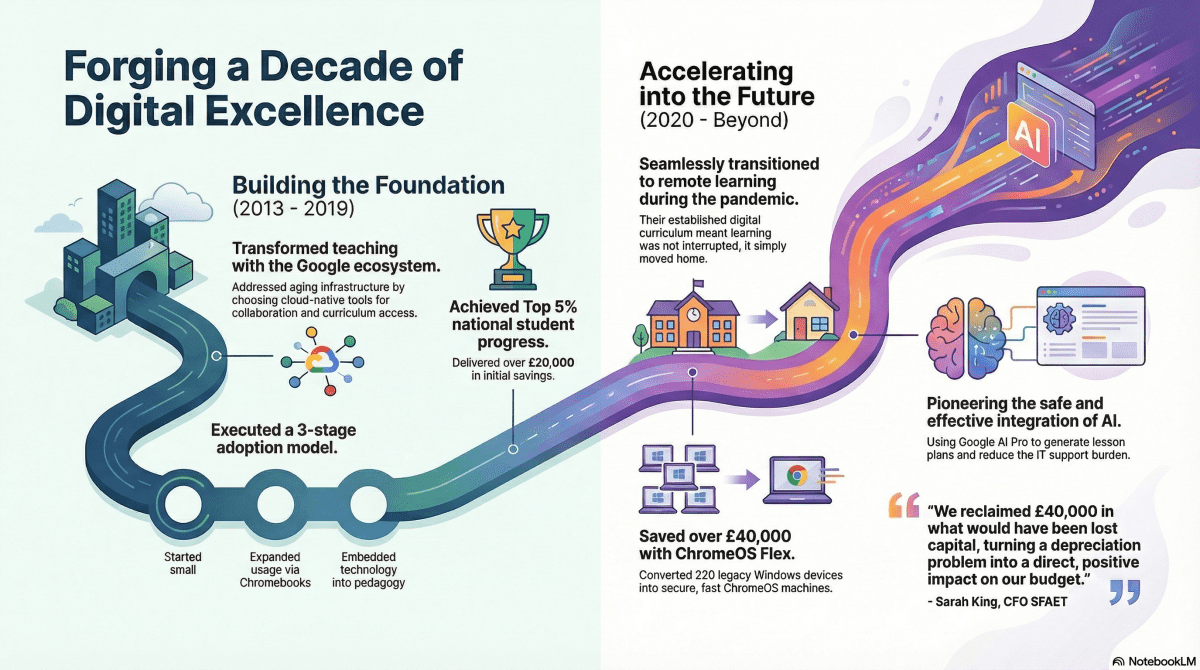
Forging a Decade of Digital Excellence: How SFAET Saved £40k and Pioneered AI with XMA

In the education sector, technology procurement is often reactive, fixing what is broken or refreshing devices on a rigid cycle. However, the most successful Multi-Academy Trusts treat IT as a strategic foundation for pedagogy, not just a utility. 

Our latest case study explores the 10-year partnership between XMA and the Success for All Educational Trust (SFAET), specifically focusing on Redden Court School. This relationship demonstrates how a long-term vision yields significant financial and operational returns. 

Practicing what we preach, we’ve used the transformative power of Google’s NotebookLM to effortlessly create an infographic based on the case study. NotebookLM also gave us the ability to make our own podcast on the subject, as well as a video! Check them out below

For everything educational, rely on XMA for your next IT project. Contact us at enquiries@xma.co.uk for more.

The Multi-Framework Strategy: How to Procure a Complete IT Estate Without the Administrative Headache

University procurement teams are well-versed in the specific mechanisms of UKUPC frameworks. You understand the compliance requirements and the procurement vehicles available. The challenge is not about understanding the frameworks. It’s about the operational burden of managing them simultaneously to deliver a cohesive IT strategy. 

Trying to piece together an end-to-end solution (from data centre to desktop) often involves juggling multiple suppliers, conflicting delivery timelines, and disjointed administrative processes. This fragmentation creates unnecessary friction and increases the workload on your internal teams. 

XMA removes this complexity. We possess the regulatory expertise to navigate the entire framework landscape on your behalf. We do not just hold a position on these agreements, we understand the intricacies of the terms and procurement regulations for each, allowing us to build a compliant, integrated solution that spans your entire infrastructure. 


A Single Route for Complex Requirements  

We act as your strategic consolidation point. Instead of raising separate tenders for hardware, software, and infrastructure, you can leverage our position across the board: 

  • Compute & Devices (NDNA & Apple): We execute large-scale deployments of Windows and Apple devices under the NDNA terms you trust, ensuring standardisation across campus. 
  • Enterprise Infrastructure (SSSNA & NEUPC): We architect your backend using SSSNA for servers and storage, and NEUPC for the critical networking layer. We align these complex installs with your device rollout schedules. 
  • Software & Peripherals (SLRA & ITRAP): We handle the granular details (licensing compliance via SLRA and essential peripherals via ITRAP) ensuring no component is overlooked. 


Expertise That Reduces Risk  

Our public sector team dedicates itself to understanding the specific procurement rules of these bodies. We ensure that every transaction meets the strict governance and audit requirements you face. By entrusting the navigation of these frameworks to XMA, you release your procurement team from the “heavy lifting” of vendor coordination. 

We deliver the technology you need, strictly adhering to the frameworks you rely on, without the administrative hassle. Talk to your XMA Account Manager or contact us at enquiries@xma.co.uk to start a conversation. 

Access Before Success: 5 Reasons One-to-One Devices Are No Longer Optional

Picture of Michael Conlon

Michael Conlon

Former teacher, school leader, and survivor of many education reforms. Now an Education Transformation Consultant, Michael specialises in turning big tech promises into actual classroom wins.

As an Education Transformation Consultant with over 25 years in teaching and leadership, I’ve seen more “next big things” in education than I can count. But one shift is different: ensuring every learner has access to their own device – properly secured and managed, but their own. This isn’t about shiny tin or staff and pupil attraction and retention – it’s about equity, opportunity, and founded on an understanding that the world of work and future learning is a fundamentally different place.

Here’s why one-to-one programs matter now more than ever:

  1. Equity is not optional
    Without universal access, we create a two-tier system: those who can participate in digital learning, and those who can’t. A personal device is today’s textbook—it’s the baseline for fairness. I’m not suggesting every minute of every lesson – far from it but that it is there, whenever and wherever you need it.
  2. Technology removes barriers, it doesn’t create them
    From tools like Immersive Reader to AI-powered learning accelerators, devices open doors for learners with different needs. Access allows every student—whether struggling or thriving—to engage on equal footing, with aids that help overcome learning challenges.


  3. Skills for tomorrow are built today
    Digital fluency is no longer a “nice to have.” It’s a prerequisite for almost every career. Students who lack consistent access risk being unprepared—not because they lack potential, but because they are under-resourced.
  4. Inclusion is powerful (and visible)
    When every child has a device, every voice can be heard. Quiet students can contribute online, collaboration happens seamlessly, and learning can extend beyond the four walls of the classroom.


  5. It’s about futures, not gadgets
    This isn’t about handing out laptops and tablets. It’s about dignity, opportunity, and ensuring that when AI, quantum computing, and the next wave of innovation comes we don’t widen the attainment gap. The future is coming fast for our country and our economy. Let’s demonstrate we are future facing.

Final Thought

We need to consider that one-to-one access isn’t a luxury—it’s the foundation of modern learning, from an age and stage when the journey with digital makes most sense. If we fail to provide it, we’re not just denying students devices; we’re closing doors.

9 Ways Schools Can Meet the Moment with Digital Confidence

Michael Conlon walks us through how schools can tackle the digital education landscape.

Picture of Michael Conlon

Michael Conlon

Michael is XMA’s Education Transformation Consultant. With over 25 years in teaching and leadership he has sat through more strategy meetings and indulged more fads than he cares to admit, but still loves help schools make sense of digital transformation—without the jargon, and ideally without the panic.

The UK Government’s digital and technology standards for schools and colleges set a clear direction: resilient infrastructure, inclusive access, and strategic leadership. At XMA, we believe in empowering educators with agnostic, future-ready solutions that meet these standards and elevate learning. Here’s how:

  1. Cloud Platforms That Work for Everyone

Whether it’s Microsoft 365 or Google Workspace, we guide schools through seamless cloud adoption, ensuring secure access, data protection, and long-term cost efficiency.

  1. Cyber Security That Protects Learning

From endpoint protection to staff training, our cyber resilience solutions align with DfE standards and keep digital environments safe for students and educators.

  1. Devices Designed for Education

We supply and configure devices that meet curriculum needs—whether it’s 1:1 student access or shared classroom sets—ensuring performance, security, and longevity.

  1. Digital Inclusion for Every Learner

We help schools audit and implement accessibility tools, ensuring that all students, no matter their learning challenges, can engage fully with digital learning.

  1. Filtering and Monitoring That Safeguards

For you’re core duty, our safeguarding solutions meet statutory guidance, giving schools peace of mind with intelligent filtering and real-time monitoring.

  1. Leadership That Drives Strategy

We work with MATs and Local Authorities to establish their digital maturity, and develop digital strategies that align with governance standards, budget realities, and long-term goals.

  1. Sustainable Server and Storage Solutions

Whether cloud-first or hybrid, our server and storage options need to meet environmental and security standards.

  1. Professional Development That Sticks

Technology is redundant if people don’t know how to use it effectively. We offer training and support that builds digital confidence across teaching and support staff.

  1. Keeping your eye on the horizon

XMA excel at anticipating and leaning into tomorrow’s technologies to bring solutions to customers that add value and improve how they work.

At XMA, we don’t push products—we build partnerships. Our agnostic approach means we focus on what works best for your context, your learners, and your goals. If you’re interested in your school becoming more Digital Confident, contact us at enquiries@xma.co.uk

Share with your network
WhatsApp
X
LinkedIn

The Right Tech for the Academic Year: A Win for Students, Parents, and Your IT Team

We all know the end of summer brings a familiar chaos. For parents, it’s the frantic rush for uniforms, stationery, and the single most important (and debated) item on the list: the student device. For schools and Multi-Academy Trusts, it’s about ensuring the technology you’ve chosen can actually withstand the reality of a new academic year. 

This year, we followed the back-to-school journey of one family to see how the right technology choices can make all the difference.  

Meet the Millers  
Proud mum Sarah has two children heading into demanding years: Chloe is starting a graphic design course at her independent school, and Tom is off to Further Education college. 

The great device debate in their house was short-lived. They’d heard good things about the usual suspects, but after kicking the tyres, they needed technology that could keep up with the daily reality of student life. 


The Right Tools for the Job 

For Chloe, the budding artist, the choice was the Samsung Galaxy Book3 360. As a 2-in-1 device, it gives her the flexibility she needs. She can type up essays in traditional laptop mode, then flip the 360-degree hinge and use it as a tablet for sketching.  

The real clincher was the combination of the stunning Super AMOLED touchscreen and the natural, paper-like feel of the included S Pen. It means the colours in her digital paintings are incredibly vibrant and accurate, giving her a significant advantage in her creative work. 

For Tom, it was all about practicality. He needed a reliable workhorse for his FE course that wouldn’t break the bank. The Galaxy Book4 was the perfect fit. While it’s an affordable, entry-level model, it doesn’t compromise on quality or performance. It’s a sleek, solid all-rounder with a modern Intel® Core™ processor, more than capable of handling his research, reports, and presentations. 


Built for the Realities of Student Life 

Chloe’s day starts in the art studio. She flips her Book3 360 into tablet mode, the high-resolution screen showing every detail of her reference photos. Using the S Pen, she sketches directly onto the screen, the pressure sensitivity allowing her to create fine lines and broad strokes just like a real pencil. In her next lesson, History of Art, she switches to laptop mode to type notes, the full-sized keyboard making it easy to keep up. At lunch, she and her friends gather around her device in ‘tent’ mode to watch a design tutorial – the Super AMOLED screen is so bright and clear they can all see it perfectly, even with the lunchtime glare. The flexibility is a game-changer. 

Tom found himself in a classic student bind: a 15-minute break to prepare for a seminar on a topic he’d only half-read the night before. Instead of panicking, he pulled up the lengthy research article on his Galaxy Book4 and asked Microsoft Copilot to summarise the key arguments. In minutes, he had a clear, concise overview, ready for the discussion. It was a perfect example of working smarter, not harder, showcasing how the device’s built-in AI tools can be a massive help for students on a tight schedule. 

Here are a few other ways these devices are designed for the rigours of education: 

  • All-Day (and then some) Battery: Both Chloe and Tom can leave their chargers at home. The battery life on the Galaxy Book series is huge. If they ever do get caught short, the super-fast USB-C charger can deliver hours of power in the time it takes to drink a coffee.  
  • The Samsung Ecosystem in Action: This is where things get really clever. Tom often jots down notes on his Samsung phone between classes, where they automatically sync and appear on his Galaxy Book4 when he sits down to study. Chloe uses her Samsung tablet as a second screen, giving her a dedicated space for reference images while she works on her main canvas. Sharing work is simple and instant with Quick Share, so there’s no more “the dog ate my homework, sir” or, more accurately, “the email got lost in my outbox”.  
  • Lightweight and Portable: These laptops are incredibly thin and light, sliding easily into a packed backpack without adding bulk.  


Peace of Mind for Parents and IT Directors 

This is where the story becomes particularly relevant for education buyers. A happy parent with a child using a reliable device is a parent who isn’t calling your IT helpdesk. 

What if a student device does have an issue?  

This is where the support comes in. Every B2B Samsung Notebook from XMA includes a 3-year, business-grade warranty as standard. If your device suffers a fault, Samsung will repair your device at our UK service centre – if it can’t be fixed, it will be replaced free of charge. This is a level of practical, responsive support that keeps students learning without disruption. If the devices are part of XMA’s Device-Management-as-a-Service, there’s even less hassle, with 24/7 break-fix, Gold Stock ready to go, and active device monitoring for any hardware and software issues. 

Furthermore, the entire range is protected by multiple layers of security, including Samsung Knox, Intel secure core at the chip level, and Windows Pro, keeping student and school data safe from threats.  
How a Stress-Free September becomes a Lower TCO 

So, what does the Millers’ stress-free September mean for a School or Multi-Academy Trust? 

It means: 

  • Fewer IT Support Tickets: Durable devices and a simple, effective warranty process mean your IT team spends less time dealing with broken hardware and more time on strategic initiatives. 
  • Improved Learning Outcomes: Students with reliable, long-lasting batteries and seamless ways to work across devices are better equipped to stay productive and engaged. 
  • Demonstrable Value: You are providing families with technology that not only performs brilliantly but is built to last the course, offering a lower total cost of ownership and proving that budget-friendly doesn’t have to mean compromising on quality.  

The Samsung Galaxy Book range provides a robust, secure, and high-performing alternative that is built for the specific demands of the education environment. 

Ready to explore how Samsung’s range can benefit your institution? Schedule a consultation with an XMA specialist to see the devices for yourself. 

Contact us at: enquiries@xma.co.uk 

Inside the University of Lincoln’s State-of-the-Art ASUS Republic of Gamers Lab

The University of Lincoln needed to revitalise its outdated computer labs. Their vision was to create a state-of-the-art facility to attract top student talent and support advanced academic work. By partnering with XMA and ASUS Republic of Gamers, this vision became the impressive Republic of Gamers Lab. 

Here’s a snapshot of the project’s success: 

  • A World-Class Immersive Facility: The lab now features over 140 high-performance PCs, including nearly 60 premier Republic of Gamers-branded systems. The setup is enhanced with ultra-wide ASUS TUF monitors, a full suite of Republic of Gamers peripherals, and a bespoke, retro 80s-themed art wall. 
  • A Versatile Hub for Innovation: This is more than just a computer lab. It’s a versatile space designed to support demanding fields like AI, robotics, and game design. It also serves as a dynamic venue for hackathons and game jams, fostering a strong sense of community. 
  • A Partnership Delivering Tangible Results: The strategic move to high-performance Republic of Gamers hardware resulted in delivering performance where it matters. The lab’s striking aesthetic and strong branding also serve as a powerful marketing asset for the university. 

See the full story behind this incredible transformation. 

Read the full case study now 

Share with your network
WhatsApp
X
LinkedIn

How Logitech G is Shaping the Future of Gaming in Education

The intersection between education and technology is constantly evolving. No longer confined to traditional lecture halls and textbooks, learning is becoming more interactive, more engaging, and increasingly, more immersive. At the heart of this transformation lies the burgeoning world of gaming, and Logitech G is at the forefront, pioneering the tools that are not just enhancing play, but also improving learning experiences within higher education. 

For years, Logitech G has been a dominant force in the gaming peripheral market, synonymous with innovation, precision, and a deep understanding of gamer needs. This commitment to gaming reaches far beyond entertainment. With Logitech G, you can support students with technology that fosters skill development, collaboration, and new forms of engagement – all critical components of the modern educational journey. 

The Future of Gaming: More Than Just Play 

The future of gaming is incredibly exciting and multifaceted, with several key trends poised to significantly impact higher education: 

  • eSports as a Mainstream University Fixture: University eSports programs are exploding globally. These aren’t just socialising clubs anymore; they are structured, competitive disciplines requiring dedication, teamwork, and strategic thinking. Universities are building dedicated esports arenas and offering scholarships, recognising the immense value these programs bring in attracting students, fostering community, and developing transferable skills. 
  • Immersive Learning Environments: Virtual Reality (VR) and Mixed Reality (MR) are moving beyond niche applications. In education, they offer exciting opportunities for experiential learning – from virtual science labs and historical recreations to complex simulations for medical or engineering students. The right peripherals are crucial for intuitive interaction within these digital worlds. 
  • Gamification in Curriculum Design: Educators are starting to adopt game mechanics (points, badges, leaderboards, and narrative structures) to make learning more engaging and motivating. This requires tools that are responsive, comfortable for extended use, and can seamlessly integrate into diverse learning platforms. 
  • Collaborative and Remote Learning: Gaming has always been social, and its collaborative nature is a perfect fit for modern educational models that emphasise teamwork and remote participation. High-quality audio and clear communication are paramount for successful online group projects, virtual study sessions, and remote coaching in esports. 
  • Accessibility and Inclusivity: The future of gaming, and indeed education, must be inclusive. This means peripherals designed for a wide range of users, accommodating different needs and preferences to ensure everyone can participate fully. 

Logitech G: Powering the Next Generation of Educational Gaming 

Logitech G isn’t just observing these trends; it’s actively shaping them. Their existing and future innovations are directly contributing to a more dynamic and effective learning environment: 

  • Peak Performance for Aspiring eSports Professionals: For university esports teams, precision, speed, and reliability are non-negotiable.
    Logitech G’s PRO Series is engineered in collaboration with top esports athletes, delivering the competitive edge students need. 
  • The Logitech G PRO X 60 LIGHTSPEED Wireless Gaming Keyboard, with its compact 60% form factor, frees up valuable desk space for dynamic mouse movements – crucial in high-stakes competitions. Its LIGHTSPEED wireless technology ensures pro-grade performance and reliability. 
  • The original Logitech G PRO Mechanical Gaming Keyboard remains a stalwart, offering tactile, responsive keyswitches preferred by many for their consistent performance during intense training and matches. 
  • When every millisecond counts, the Logitech G PRO X SUPERLIGHT 2 Wireless Gaming Mouse provides featherlight design and HERO 2 sensor for exceptional tracking accuracy and speed, allowing for swift, precise actions. 
  • Crystal-clear communication is vital for team strategy and coordination. The Logitech G PRO X 2 LIGHTSPEED Wireless Gaming Headset delivers professional-grade sound clarity and advanced microphone technology, ensuring every callout is heard. Its comfortable design allows for hours of focused participation. 
  • Enhancing Immersion and Interaction: As VR and MR become more integrated into curricula, the need for intuitive and comfortable peripherals will grow. Logitech G’s research into haptics, audio, and ergonomic design will be pivotal in creating more natural and engaging interactions within these virtual learning spaces. Imagine a medical student feeling the subtle resistance of a virtual surgical tool, or an architecture student intuitively manipulating a 3D model – Logitech G is working towards making these experiences seamless. 
  • Supporting Sustained Engagement: Whether it’s a long study session using gamified learning modules or an extended esports practice, comfort and durability are key. Logitech G’s focus on ergonomic design and high-quality materials ensures that their peripherals can withstand the rigours of daily use in an educational setting, promoting sustained engagement without discomfort. 

Logitech G’s Vision: An Integrated and Empowering Future 

Logitech G is preparing for a future where the lines between gaming, learning, and professional development blur. They see a world where the skills homed in gaming – critical thinking, problem-solving, collaboration, and adaptability – are seamlessly transferred to academic and professional success. Their commitment is to provide the tools that empower this integration, fostering environments where students can learn, compete, and create without limitations. This includes continued innovation in software that allows for customisation and optimisation of peripherals, creating personalised experiences that cater to individual learning styles and gaming preferences. 

XMA: Your Partner in Building the Future of Educational Gaming 

Navigating the rapidly advancing world of gaming technology and understanding how to best integrate it into your institution’s unique environment can be challenging. This is where XMA, in partnership with Logitech G, can provide invaluable assistance. 

XMA understands the specific needs and complexities of the higher education sector. Our team of experts can help you: 

  • Identify the Right Logitech G Solutions: From outfitting a state-of-the-art esports arena to equipping classrooms with engaging learning tools, we can help you select the Logitech G G PRO series keyboards, mice, and headsets that align with your specific goals and budget. 
  • Design and Implement Tailored Setups: We work with you to understand your space, curriculum needs, and student population to design and deploy Logitech G peripheral solutions that boost engagement and performance. 
  • Provide Ongoing Support and Expertise: XMA offers comprehensive support to ensure your Logitech G investment continues to deliver value, helping you adapt to future technological advancements. 

The future of gaming in education is bright, offering unprecedented opportunities to engage students and enhance learning outcomes. Logitech G is providing the innovative tools to make this future a reality. Partner with XMA to harness the power of Logitech G gaming peripherals and position your institution at the cutting edge of educational excellence. 

Contact your XMA account manager today, or talk to us at enquiries@xma.co.uk to discuss how we can help you choose the right Logitech G products and peripherals for your unique needs and build a future-ready learning environment. 

How Meta is Stitching Mixed Reality into the Fabric of Higher Education

For years, Mixed Reality (MR) has hovered on the periphery of education – many seeing it as an exciting novelty, a glimpse into a potential future. But that future is rapidly becoming the present. For Higher Education institutions, Meta Quest devices (like the Meta Quest 3 and Meta Quest 3S), powered by Meta Horizon Managed Solutions, are no longer just intriguing gadgets; they are poised to become integral tools woven into the everyday learning experiences of students. 

Immersive Learning That Delivers Results 

With Mixed Reality, you can imagine students not just reading about complex cellular structures but shrinking down to explore them, or trainee surgeons practicing complex procedures in a zero-risk environment. This is the power Meta Quest brings to the classroom. It’s about immersing students in experiences that make abstract concepts tangible and bring complex ideas to life.    

The data supports the impact: 

  • 63% of VR learners absorb information more quickly than traditional e-learners.1 
  • 59% complete hard skills training faster.2 
  • 67% report higher engagement levels in soft skills training.3 

Meta Quest provides the ultimate learning edge – a safe space for students to fail, iterate, create, and develop critical skills. This includes both hard skills, by simulating complex or dangerous scenarios safely, and soft skills, by allowing learners to experience different perspectives.    

Institutions are already seeing significant results: 

“Across 83 Inspired Education Groupschools already using immersive technology in the classroom, 90% of students reported increased engagement and interest in their lessons, along with a 25% boost in confidence in their knowledge. Additionally, 85% of teachers found virtual and mixed reality to be a valuable tool to enhance their teaching. Students also experienced a 15% improvement in their academic performance on multiple-choice assessments.” 

Meta Horizon Managed Solutions: Making Immersive Learning Seamless and Secure 

Adopting new technology at scale can seem daunting. That’s where Meta Horizon Managed Solutions comes in. This comprehensive hardware and software solution is specifically designed for educational environments, providing everything you need to securely and easily manage users, devices, and metaverse experiences.  Crucially, two years of Meta Horizon Managed Solutions are included with every hardware purchase, with a special education offer for Device Lifetime Access available for an additional £100 per device. 

Key benefits include: 

  • Effortless Deployment: Integrate into your existing IT workflows and pre-configure headsets for quick roll-out across campus. Compatibility with MDM providers like Ivanti and Microsoft Intune ensures smooth adoption.    
  • Simplified Management: An all-in-one solution to manage users (via company-managed Meta accounts), devices (with advanced controls), and access to experiences. Features like Shared Mode allow multiple users on single devices, while multicasting enables educators to view multiple students’ progress simultaneously for effective training. Identity and access management, including Single Sign-On (SSO) integration, and app management controls are also included, along with dedicated customer support.    
  • Robust Security: With privacy ‘baked in’ from the start, multi-layered security features, privacy controls, 2-factor authentication, remote wipe capabilities, and other essential controls, you can be confident that student data is protected. Meta Horizon Managed Solutions is ISO/IEC 27018 certified, and Managed Meta Accounts have achieved SOC 2 compliance, verified by independent audits.    
  • Enhanced Collaboration & Productivity: Bring students and educators closer together, wherever they are, using tools like Meta Horizon Workrooms and customisable Horizon OS avatars. Minimize distractions and boost productivity with features like virtual workspaces, tracked keyboard support, calendar integrations (Google & Outlook), Remote Desktop access to Windows PCs, and integrations with Microsoft 365 apps and Microsoft Mesh for immersive Teams meetings. 
  • Scalability: Train students safely and effectively at scale, leveraging the platform’s robust features.  

An Ever-Expanding Universe of Content 

A common concern with adopting new educational technology is the longevity and breadth of available content. Meta addresses this head-on. Powered by Meta Horizon managed solutions, you gain access to a vast and constantly growing ecosystem from over 900 world-class content providers and Independent Software Vendors (ISVs). From specialised training simulations (like Oxford Medical Simulations, UbiSim) and language learning (Immerse) to collaborative science labs (Labster, Nanome) and platforms fostering soft skills (Bodyswaps), the possibilities are continuously expanding. Your students will never run out of things to learn, explore, and engage with.

XMA: Your Partner for Hassle-Free Meta Integration 

Bringing this transformative technology into your institution should be exciting, not stressful. XMA specialises in delivering hassle-free, bespoke Meta solutions tailored specifically for your classrooms and educational goals. We handle the complexities so you can focus on unlocking the potential of Mixed Reality for your students. 

Watch our On-Demand Webinar all about Meta Horizon Managed Solutions in the world of Education: Reimagine the World of Education with Meta Horizon Managed Solutions 

Experience the Future of Learning with XMA 

Ready to see how Meta Horizon Managed Solutions can redefine learning at your institution? 

Send us an email at enquiries@xma.co.uk or talk to your XMA account manager. 

1-3. CCS Insight, Survey of 500 VR users in the US and UK (study commissioned by Meta for Work), 2023 

Fill in the Form to Download the Case Study

Fill in the Form to Download the Case Study

Fill in the Form to Download the Case Study

Skip to content
Monitoring by Hotjar Monitoring by Hotjar