Archive

Navigating Lead-Time Uncertainty with the Scottish Web and Proprietary Framework

The technology industry is experiencing a fundamental shift in component availability. Market data indicates a global DRAM shortage as manufacturers prioritise High Bandwidth Memory (HBM) for AI data centres. This reallocation of production capacity is creating significant uncertainty regarding component availability, lead times and pricing for client devices throughout 2026.


Mitigate Project Delays with XMA

The framework provides a compliant and direct route to a wide range of web-based and proprietary technology from Apple, HP, Samsung, Lenovo, and Microsoft.

As the sole supplier on the Scottish Web and Proprietary Framework, XMA works directly with global suppliers to mitigate supply disruptions and protect your project timelines. However, we believe the current memory and storage shortages will impact on the Framework. Please engage with us as early as possible in order to address some of your concerns and needs.


The Impact of Structural Price Increases

While product availability is a primary operational concern, the financial implications are equally significant. Market analysts predict that hardware prices could rise by over 20% in the first half of 2026 as component costs are passed down to end users. Specifically, DDR5 memory prices have already quadrupled since late 2025.

For public sector organisations in Scotland, this creates a volatile procurement environment where established budgets may no longer be sufficient to meet hardware requirements if purchases are delayed. Again, early engagement will ensure you have information about the latest pricing to inform your decisions.


Strategic Tools for Supply Resilience

To help you find solutions for both immediate and future needs, we provide several mechanisms to ease the pressure on your digital strategy:


  • Free 6-Month Bonded Storage: Secure the hardware you need now and keep it in our managed facilities at no additional cost for half a year.

  • Deferred Warranty: We provide a deferred warranty for products held in bonded storage. This means your warranty only commences on the date the device is received at your location, not the date of purchase.

  • Flexible Withdrawal and Logistics: Withdraw devices on demand with free delivery to as many UK locations as your project requires.

  • Finance and Leasing: Use our range of finance options to spread the cost of hardware, allowing you to secure stock early without straining immediate cash flow.


Local Expertise, Unmatched Experience

The framework is a pathway for consultation, not just a procurement tool. Our dedicated team is based in Scotland and understands the specific operational landscape of the Scottish public sector.

We provide free consultation and will visit your organisation to listen to your goals. Our experience is particularly relevant for large-scale 1:1 device projects within Local Authorities across Scotland. We understand the end-to-end strategic and operational processes required to make these projects successful, offering a level of insight that is unmatched in the region.


Partner With XMA For Your Next Project

The current memory shortage and production shifts are expected to persist well into 2027. The earlier we can begin the consultation process regarding your upcoming needs, the more we can do to mitigate supply delays. By engaging with the framework now, you can avoid the lead-time bottlenecks hitting the wider market and ensure your users have the tools they need when they need them. For further details on how we support Scottish public sector ambitions, you can view our frequently asked questions here.


Contact our Scottish team today:

· Email: scotlandsales@xma.co.uk

· Phone: 0115 846 4100

That’s A Wrap! Highlights and Insights from BETT26

Picture of Michael Conlon

Michael Conlon

Former teacher, school leader, and survivor of many education reforms. Now an Education Transformation Consultant, Michael specialises in turning big tech promises into actual classroom wins.

Reflecting on BETT 2026, what emerged, beyond the multiple pieces of hardware and software that do more or less do the same thing, was a much calmer sense of direction to last year when AI was being plastered over every stand and without any sense of purpose. More specifically at XMA we could sense the following.


The value of community: We’re always fond of saying “Devices don’t teach children. Teachers teach children”, and so BETT is a place for people to connect, to share ideas and progress, inspire and influence each other in ways which are authentic and important and stripped of the hype. Teachers and leaders spent purposeful time exploring what is in the market and connecting with vendors who are looking to add value rather than just deliver transactional technology. At XMA we had endless conversations around the present and future of learning and teaching and how our solutions and capabilities support a digital strategy, from devices to deployment, thinking about the “Why” and less about the “What”. We ended Day 2 with marvellous dinner with our key customers, allowing them to network and build a community of their own.

We found it hugely impactful to have some of our customers deliver talks in our mini theatre and reminded us that they are often our best champions, talking out the value of our partnership and how XMA deliver solutions that really support their needs and ambitions and gave us the opportunity to expose to other potential customers the breadth of our capability.


Human centred AI: AI was an inevitable focus for attendees, speakers and vendors but this year there was a more thoughtful, grounded approach. We really began to get down into the weeds of how AI actually supports teaching and learning, be it from Microsoft or Google, or embedded in apps like Canva, Kahoot, Adobe and Thinglink, to mention just a few. This is an important step and customers were beginning to challenge the value that some of them bring. Professor Hannah Fry and Amol Rajan explore the ethics of AI in their Keynote, very much reflecting our approach in XMA that AI must retain that human connection that support pedagogical principles. There are issues like misogyny and bias that schools need to tackle through Digital Literacy programs and be assured that what they are putting in front of teachers and pupils is part of a framework that has guardrails and can evolve over time.


Esports: Esports made its presence felt again, with schools beginning to value gaming as a legitimate way of introducing digital skills and Team benefits. They’re understanding the potential of how Esports help explore things like event management, broadcasting, team leadership and nutrition, a very credible cross-curricular dynamic. New qualifications are starting to cement this understanding and standards and frameworks are being built to ensure this is not just a flash in the pan.


On-device AI: Terms like NPU (neural processing units)  and TOPS (Trillion operations per second) are beginning to become more familiar with customers as they begin to get to grips with the idea of AI work being done on device rather than in the cloud, and what speed and sustainability advantages a device with these kinds of chips will have. Vendors like Microsoft are building platforms that take advantage of this, allowing teachers the ability to build AI tool that support learning and teaching aligned to the educational standards in your country.

There was a good mix of smaller vendors, table top stands and technology-adjacent, many of whom we’re confident will grow and grow until their stands are prominent in the main floor. There is always almost too much on show at BETT and for many of our new attendees they felt it quite overwhelming at first. Despite being a veteran I still get blinded by the dozens of screen manufacturers and little STEM robot solutions that there are – an almost too crowded market in some respects, Dozens of talks and presentations, vendors and software, the show is at it’s best when people can navigate it through their field of interest and plan their day with comfortable shoes!


Finally, some solutions really come to life when you see children using them – that is often a clue in terms of how engaging the technology is and a reminder that we teachers work in service of these children’s future, so we should value what they tell us. I’d have a purely school children day but I realise that for some, many hundreds of kids in that space would be too much!

New White Paper: How Esports Facilities Impact University Recruitment and Student Success

The UK higher education sector is in a period of intense competition. To secure the best talent, institutions must offer facilities that deliver a tangible return on investment. For years, esports labs were viewed by many observers as expensive recreational add-ons. 

That view is now obsolete. 

A new survey conducted by XMA in partnership with Logitech provides the hard data to correct the record. We surveyed 1,000 current and prospective university students to separate anecdote from fact. The results are conclusive: advanced computing facilities are directly correlated to a university’s ability to attract students, support their wellbeing, and prepare them for the modern workplace. 

Here is the reality of the student demand. 

A Deciding Factor in Recruitment 

For the majority of prospective students, a university’s digital infrastructure is a primary litmus test for the institution’s quality. 

The report reveals that 60% of respondents state that the presence of dedicated gaming facilities would encourage them to choose a specific university. Perhaps more importantly for risk-averse administrators, only 1.5% said it would discourage them. 

The rhetoric that gaming distracts from serious study holds no weight with the students themselves. Instead, a well-equipped lab signals that the university understands the technology and culture that defines their generation. It converts an IT investment directly into a recruitment asset. 


The Demographic Reality Check 

University administrators often view “gamers” as a niche male demographic. The data dismantles this stereotype entirely. 

88% of students surveyed play games at least once a week, with 50% playing daily. Furthermore, this is not a gender-specific activity. While 93% of male respondents play weekly, a massive 85% of female respondents do the same. 

Investing in esports and advanced computing does not serve a minority interest, it serves the vast majority of your student intake. If you ignore this demographic, you ignore nearly 9 out of 10 students walking onto your campus. 


More Than Just Gameplay: The Academic Link 

Students view these facilities as practical learning environments, not just arcades. They see a direct line between high-spec hardware and their professional futures. 

  • Career Preparation: 83.4% of students say that access to emerging technologies (like AI, VR, and high-spec computing) is important for their future careers. 
  • Skill Transfer: Students explicitly associate these facilities with developing marketable skills in game design (72%), programming (54%), and digital content creation (49%). 
  • Course Selection: 44% of respondents stated that access to gaming facilities would make them more likely to choose a technology-focused course. 

This data indicates that an esports lab functions as a “third space” on campus, a hub for skill acquisition and collaboration that students are actively seeking. 


The Hardware Requirement 

Students are clear about their expectations. Standard library PCs are insufficient for the workloads required by modern degrees. 

37% of students explicitly want high-performance computers to support their coursework. Furthermore, 33% require access to content creation tools. 

To meet this demand, universities must provide industry-standard equipment. This means high-performance workstations and peripherals, such as the Logitech G range, which offer the precision and durability required for both competitive esports and intensive creative workloads like 3D modelling and video production. 


XMA’s Proven Delivery 

Data is useful, but execution is what matters. Building these environments requires more than just buying PCs, it requires complex infrastructure planning, security compliance, and strategic procurement. 

XMA has a demonstrable history of delivering specialist facilities for UK universities. Our work with Teesside University to deliver their industry-leading gaming labs, and our engagement with the University of Lincoln to build their esports facility, showcase our capability. We manage the end-to-end process to create robust, high-performance environments that last. 

The Verdict 

The argument is settled. Esports labs have a measurable, positive impact on student recruitment and academic outcomes. 

The question is no longer if a university should invest in advanced computing facilities, but when. If you are ready to discuss the design and delivery of a facility that aligns with your institution’s strategic goals, contact the XMA public sector team at enquiries@xma.co.uk today. 

Work Like a Pro: Why ‘Good Enough’ IT Tools Are Costing Your Business

In today’s hybrid work model, clear communication and reliable collaboration are non-negotiable. Many organisations, however, still rely on consumer-grade tools to bridge the gap, like personal earbuds for critical calls or the built-in webcam for a high-stakes meeting. 

This ‘good enough’ approach is often a false economy. It’s the daily friction of background noise, patchy calls, and unsecure software that drains focus, confidence, and productivity. It’s the difference between just getting through the day and performing at your best. 

Jabra’s “Work like a pro” concept is built on one promise: professional-grade tools create professional outcomes. This isn’t about features for their own sake; it’s about delivering measurable improvements to how your teams sound, meet, and focus. 


Sound Clear. Stay Focused. 

Think about the daily frustrations of poor audio. “Sorry, you’re breaking up”. The dog barks. The café chatter is louder than your voice. Poor audio isn’t just a mild annoyance. Research shows it can increase employee stress levels by 55%1

Jabra Evolve headsets are built for modern work. They are engineered to solve these specific problems: 

  • Jabra Clear Voice™ technology cuts through background noise so you sound sharp, confident, and credible. 
  • Industry-leading active noise cancellation blocks distractions, allowing you to “Focus like a pro” no matter what’s happening in the background. 

The result is a measurable improvement in communication. A study on modern meetings found that teams using Jabra professional tools report +27% clearer conversations and +35% more confident communication2


Be Seen and Heard Like a Pro 

The same principle applies to video. Being seen doubles attention and engagement. Yet, many meeting rooms are not properly equipped for today’s needs. In fact, only 15% of employees report that all their meeting rooms are equipped for video meetings2

Jabra PanaCast video solutions are designed to “turn any space into an inclusive meeting room”. 

  • They provide panoramic, full-room coverage (often 180°) to ensure everyone is in the frame, even in small huddle spaces. 
  • Intelligent framing automatically keeps the conversation flowing naturally, keeping everyone in the picture. 

This focus on inclusive video leads to +47% stronger collaboration and +16% more trust in meetings2. Furthermore, the devices are practical for IT. The PanaCast 40 VBS, for example, can go from box to first meeting in under 12 minutes with a secure, wall-mounted installation3


Manage and Protect Like a Pro 

Beyond the call quality, Jabra’s professional portfolio is built for business operations. Consumer devices were not built to protect business data and create significant headaches for IT departments. 

Jabra solutions are different: 

  • Device Management: The Jabra+ dashboard provides full fleet control, allowing IT teams to update, troubleshoot, and manage all devices remotely from one secure platform. 
  • Security: Jabra devices are designed with enterprise-grade protection. They feature end-to-end encryption to ensure professional conversations and data stay private. 
  • Future-Proofed for AI: Jabra is also built for the next wave of work. Evolve2 headsets feature 97% accurate voice pickup for AI4, enabling reliable, hands-free interactions with AI assistants. 


Go from Good Enough to Great 

This focus on durable, secure, and high-performing tools is why 80% of Fortune 500 companies trust Jabra5

“Good enough” tools get you through the day. Professional solutions help you stand out. It’s time to stop making do and start leading the way. Go from good enough to great

Ready to upgrade? Explore Jabra’s professional audio and video solutions on our XMA Store or reach out to us at enquiries@xma.co.uk to find out how we can help your organisation work smarter and collaborate more effectively. 


[1] Jabra Hybrid Ways of Working, 2023 Global Report.

[2] A Jabra study at the London School of Economics’ Behavioural Lab on the impact of technology on people in modern meetings

[3] Based on GN internal UX testing, March 2025.

[4] Jabra Commercial Disclaimers – Force Technology study 2024.

[5] Jabra Sales Data

What to Do with Your Old Headsets? The Swap, Save & Sustain Programme

In any business environment, IT peripherals are replaced frequently, and headsets are one of the most common items. This often leads to an overlooked challenge: a growing collection of old, non-functional, or obsolete headsets from various brands, taking up space in desk drawers and storage cupboards. 

These devices are electronic waste (e-waste), which is the fastest-growing waste stream globally. Simply disposing of them in general waste is not a responsible option, yet finding a simple, secure, and cost-effective recycling path is often difficult. 

XMA supports initiatives that provide a practical solution to these exact challenges. We are highlighting the “Swap, Save & Sustain” programme from EPOS, designed to help organisations responsibly recycle old technology while providing a clear financial benefit. 


How the EPOS Recycle Programme Works 

The programme is a straightforward process designed for any new or existing customer, particularly those managing a mixed estate of headsets from different manufacturers. 

Here is the step-by-step process: 

  1. Request Bins: Contact your XMA account manager. We will coordinate with EPOS to have headset recycling bins delivered to your offices. 
  1. Collect Old Devices: Fill the bins with your organisation’s old headsets. This programme accepts any brand and any type, whether they are wired or wireless Bluetooth® devices. 
  1. Arrange Collection: Once you have a minimum of 100 headsets, EPOS will arrange to collect the old units at your convenience. 
  1. Responsible Recycling: The collected headsets are then assessed to be properly reused or recycled, ensuring they are diverted from landfill. 


The Business Outcomes: Cost and Compliance 

This programme delivers two tangible business outcomes, addressing both financial and sustainability objectives. 

  1. Financial (Save) For recycling your old devices, you will receive a discount when you place a minimum order of 100 or more new EPOS headsets. This makes your next technology refresh more cost-effective.
  2. Sustainability (Sustain) This is a critical component for organisations focused on Environmental, Social, and Governance (ESG) targets. Upon completion of the recycling process, you will receive a certificate from EPOS.

This certificate formally recognises your commitment to sustainability and details the total weight of e-waste you have successfully diverted from landfill. This provides auditable proof that can be used directly in your organisation’s sustainability reporting. 


Why This Matters: The Data 

Choosing to recycle IT peripherals has a measurable positive impact. 

  • Reduces E-Waste: Certified recycling channels ensure that small IT accessories, which frequently end up in landfill, are treated responsibly. 
  • Conserves Materials: Headsets contain valuable resources like copper and plastics. Recycling reduces the demand for new virgin materials. 
  • Avoids Carbon: Estimates suggest that reusing a single corporate-grade headset can avoid up to 12kg of CO2 equivalent emissions by removing the need to manufacture a new device. 


Get Started 

The EPOS Swap, Save & Sustain programme provides a practical, financially sound method for managing the lifecycle of your old headsets and visibly demonstrating your commitment to sustainability. 

To take advantage of this programme, please get in touch with your XMA account manager or contact us directly at enquiries@xma.co.uk. 

Android Desktop: An emergency option for when your laptop is broken, or a paradigm shift in client devices?

This is the first in a series of blog posts exploring Android Desktop. Our Head of Pre-Sales, Scott Wright, will be looking at the current state of Android Desktop, following its improvement as release approaches, examining use cases, looking at essential apps & peripherals and more. 

Picture of Scott Wright

Scott Wright

Scott is XMA’s Head of Pre-Sales. An IT industry greybeard, he violated his own rule about being an early adopter when he bought the first Android phone at launch and hasn’t regretted that decision.

What is Android Desktop?  
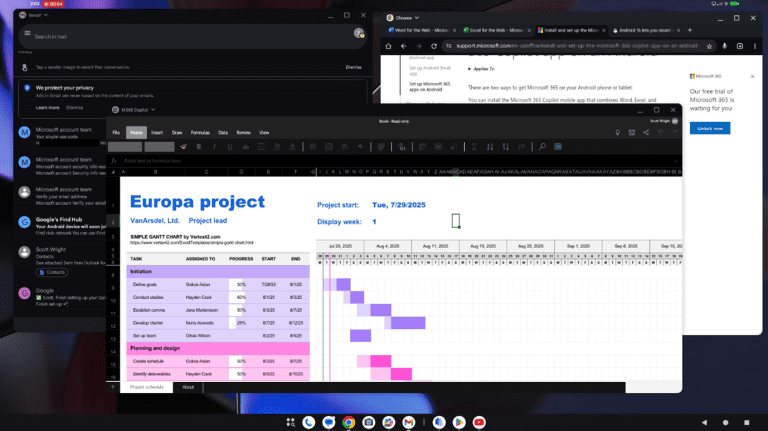
Android Desktop is a desktop-like experience for Android phones when connected to an external display, and typically also to a keyboard and mouse. It provides a larger display area, a taskbar, applications in moveable, resizable windows and so forth with the intent to make your phone a practical device to work on. It is currently available only on beta versions of Android 16 which are available on selected Pixel and other devices but will become a core Android feature. Apple is also working on an equivalent for iPhone but, as usual, they are keeping their cards close to the chest. More on that when there is news. 

A desktop mode for phones, when connected to suitable equipment. is not a new idea. Several phone manufacturers have offered their own takes on this, most notably Samsung with their DeX offering that launched in 2017. DeX was arguably a little ahead of its time, applications were not universally available with a web interface and phone hardware was significantly less powerful than today. There is also a concern with adopting vendor specific solutions, although Samsung, for example, are as far from a fly-by-night company as you can get. The availability of a vendor agnostic solution which is a core part of the Android operating system has put this back onto many organisations’ radars due to potential reductions in devices, benefits for frontline workers and more. 

How to Access Android Desktop 
If you want to try this yourselves then you’ll need a Beta version of Android 16 (ideally the current version QPR1 Beta4 but at least Beta2) and a suitable device. A Pixel 6 or newer is supported and some other vendors do also offer Beta versions of Android to their users. Enrolling in the Beta program and updating your device is quick and easy with a Pixel and you can revert back but do be aware this will likely require a device wipe. For other vendors see their instructions and warnings, some are more involved and complex than others.  

All of the usual caveats around Beta programs do, of course, apply. There will be incomplete functionality, bugs, issues and more so do consider if you should do this to your device. I have a laptop, my personal phone and a spare work phone that just needs the SIM swapping over to be running again so I have lots of options if I hit a problem. Do also note, if this is a work-provided device, then you should seek permission before installing a Beta OS and may need your device profile changing to permit that and to permit access to the developer options (which you will need). 

If you are using a Pixel device then go to the “Your eligible devices” section at the link below, opt in and then perform a system update. I found this to be a very straightforward process. 

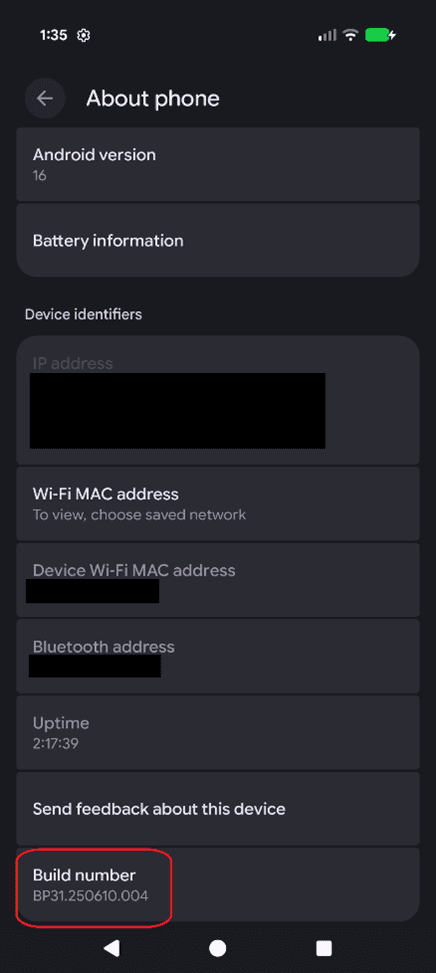
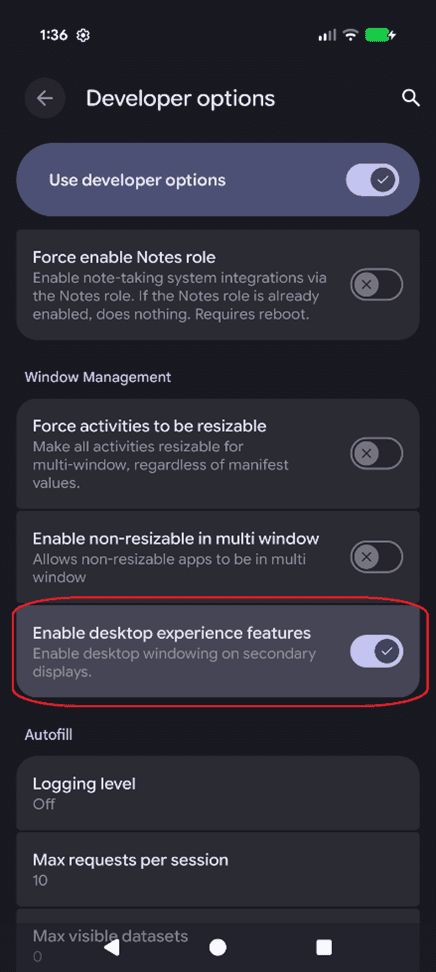
After installing Android 16 Beta then you will need to enable the developer options. To do this go into settings and navigate to About phone > Build number (bottom of the menu). Tap on the build number repeatedly until you either get a message telling you that developer options are enabled or until you are asked to unlock the device (pin, biometrics, etc). The developer options will now be available. It’s a very long menu so search for Enable desktop experience features and enable it.  

Now you can connect your Android device to suitable peripherals, most USB-C laptop docks and docking monitors will work to provide a display, keyboard and mouse to your Android device. 

More To Come 
There are lots of questions to be answered – What’s the best way of accessing M365 applicationsWhat specification of device is needed for a good experience? What are the essential peripherals, both for the desk and when travelling? What apps cannot be used successfully? Follow along with me as I explore what Android Desktop can and can’t do as I try to live with it as a work device. 

The PSTN and ISDN Switch-Off Is Happening. Your Business Needs a Plan.

The UK’s traditional phone network, the Public Switched Telephone Network (PSTN), which also includes Integrated Services Digital Network (ISDN) lines, is being permanently switched off. The final date for this is 31st January 2027. As of September 2023, it is no longer possible to buy new PSTN or ISDN services.

This is not a simple change. It will affect any device that uses a traditional phone line. This includes not just your office phones, but also other systems such as:

  • Fax machines
  • Alarm systems (intruder and fire)
  • Door entry systems
  • CCTV
  • EPOS (Electronic Point of Sale) terminals
  • Franking machines
  • Telecare and medical alert devices

If your business relies on any of these, you need to act now to avoid service disruption. One year ago, we told you about the initial changes. Now, let’s see if there have been any crucial updates.

Why is this happening?

The PSTN is old technology. It’s expensive to maintain and cannot deliver the speed or reliability required for modern business communications. The move to digital, IP-based services like Voice over Internet Protocol (VoIP) is a necessary technological step forward.

What does this mean for your business?

All voice and data services that currently use the PSTN or ISDN will need to be migrated to an IP-based alternative. This means you will be using your internet connection to make calls and transmit data. The benefits of moving to a digital system include:

  • Cost Savings: Lower monthly fees and reduced hardware costs are common.
  • Flexibility: Your staff can work from any location with an internet connection. It is also straightforward to add or remove users as your business needs change.
  • Improved Functionality: Modern VoIP systems offer advanced features like video conferencing, call routing and integration with other business software.
  • Business Continuity: In the event of an outage, calls can be automatically rerouted to other locations or mobile devices, ensuring you stay connected.

What you need to do

The 2027 deadline is final. To ensure a smooth transition, you should start planning now. XMA can help you by:

  1. Auditing Your Systems: We will identify all devices and services in your organisation that rely on the PSTN or ISDN. This includes not just the obvious, but also the easily overlooked systems like alarms and payment terminals.
  2. Assessing Your Connectivity: We will analyse your current internet connection to ensure it has the capacity and reliability to handle your voice and data traffic. We can recommend and implement any necessary upgrades.
  3. Migrating Your Services: We have partnered with RingCentral, a leading provider of cloud communications solutions, to offer a straightforward migration path to VoIP. We will manage the process for you, from planning to implementation, to ensure a seamless transition with minimal disruption to your business.

Don’t wait until the last minute. The move to all-IP is a significant change, and leaving it too late could result in a loss of service and impact your business operations.

Talk to your XMA Account Manager, or contact us today at enquiries@xma.co.uk to discuss your requirements and create a migration plan that is right for your business.

Precision Meets Purpose: How CHERRY Supports Critical Work Across Every Sector

In today’s fast-paced digital world, the tools we use everyday matter more than ever. Whether you’re strategising in a corporate office, inspiring minds in a classroom, or ensuring the smooth operation of government services, the right technology can make a measurable difference. Enter CHERRY—a brand renowned for precision, reliability, and innovation. With a rich heritage of engineering excellence and a forward-thinking approach, CHERRY has established itself as a trusted partner across a multitude of industries. Here’s how CHERRY is making a real impact in the sectors that keep our society functioning. 

Enabling Productivity Through Precision 

In the demanding corporate environment where efficiency is paramount, employees require tools that enhance focus and comfort. CHERRY’s ergonomic keyboards, such as the popular CHERRY STREAM KEYBOARD, and mice like the CHERRY GENTIX 4K are meticulously designed for an optimal user experience. The CHERRY STREAM KEYBOARD is known for its quiet keystrokes and unbeatable typing feel, thanks to its SX scissor mechanism. This allows professionals to work longer and smarter with fewer disruptions. The GENTIX 4K mouse, with its ultra-high resolution optical sensor, offers sufficient precision and speed to satisfy even the most demanding users of 4K monitors. The result? Improved productivity, reduced physical strain, and technology that empowers high-performance teams. 

Built for Security and Stability 

Government organisations demand hardware that is secure, compliant, and exceptionally durable. CHERRY addresses these stringent requirements with products like the CHERRY KC 1000 SC, a smart card-enabled keyboard providing secure PIN entry. This keyboard, and others in CHERRY’s security lineup, feature reliable components that meet the highest standards, including FIPS-201 compliance for the KC 1000 SC. From local council offices to national government agencies, CHERRY helps maintain the security and smooth operation of public services. 

Adaptable, Dependable, and Designed to Serve 

Beyond specific government functions, the broader public sector—encompassing transport, housing, libraries, and local services—needs technology that is as hardworking as its personnel. CHERRY’s versatile and cost-effective solutions deliver lasting value and dependable performance, even in high-traffic public-facing environments. The brand’s adaptability ensures it remains a preferred choice for a wide array of public services. 

Technology That Grows with Learners 

In classrooms, laboratories, and diverse learning environments, CHERRY provides the durability and ease of use that the education sector requires. Built to withstand the rigors of frequent use, CHERRY devices are ideal for students of all ages and educators who depend on reliable performance day in and day out. The intuitive design of products like the CHERRY STREAM KEYBOARD, also available in a compact TKL version without the number pad, helps shorten the learning curve and supports the development of digital fluency from an early age. 

One Brand, Many Solutions 

CHERRY’s core strength lies in its ability to cater to diverse sectors with a consistent level of quality and commitment. Its products are more than just peripherals; they are essential tools that enable productivity, maintain security, support learning, and deliver public value. As digital transformation continues to reshape every sector, CHERRY stands as a steadfast partner, delivering technology that not only meets today’s needs but also anticipates tomorrow’s challenges. 

Ready to discover what CHERRY can do for your organisation? Get in touch with your XMA Account Manager or email enquiries@xma.co.uk to explore CHERRY solutions tailored to your specific sector. 

Visit our Cherry Partner Page to learn more. 

Share with your network
WhatsApp
X
LinkedIn

Venues, Be Prepared: Martyn’s Law is Coming

The UK government is set to implement Martyn’s Law, officially known as The Terrorism (Protection of Premises) Act 2025, a new piece of legislation designed to enhance public safety and security at venues across the country. This law, driven by the tragic events at the Manchester Arena in 2017, will place new responsibilities on a wide range of public spaces.

The Terrorism (Protection of Premises) Act 2025 received Royal Assent on April 3, 2025, and while an implementation period of at least 24 months is anticipated to allow for the establishment of the regulator (the Security Industry Authority – SIA) and for businesses to prepare, the time for venues to start planning is now.

The core purpose of Martyn’s Law is to ensure that those responsible for publicly accessible locations are prepared for, and can respond to, terrorist attacks. It aims to embed a culture of security, ensuring that appropriate and proportionate measures are in place to protect people. This will affect a wide array of public spaces, including but not limited to, community centres, places of worship, libraries, museums, galleries, theatres, sports grounds, and larger entertainment venues.

Key Adaptations Venues Will Need to Make:

Martyn’s Law will introduce a tiered approach based on the capacity of the venue, impacting a significant number of organisations:

  • Standard Tier: This is expected to apply to venues with a capacity of 200 to 799 individuals. Key requirements will likely focus on undertaking risk assessments and implementing “reasonably practicable” and low-cost security measures. This will also involve providing staff with appropriate terrorism protection training and preparedness plans.
  • Enhanced Tier: Venues with a capacity of 800 or more individuals will fall under this tier. They will face more stringent requirements, including conducting detailed risk assessments, developing and maintaining a comprehensive security plan, and potentially implementing physical security measures such as CCTV, intruder detection, and secure communication systems. They will also need to formally notify the SIA of their premises and appoint a designated senior individual responsible for compliance.
  • Risk Assessment and Planning: All in-scope venues will need to formally assess the terrorism risks they face and develop clear procedures for how they would respond in the event of an attack. This includes plans for evacuation, invacuation (lockdown), and communication with staff and the public.
  • Staff Training: A crucial element will be ensuring that staff are adequately trained to understand the risks, identify suspicious activity, and know how to enact security procedures effectively.
  • Collaboration with Authorities: Enhanced Tier venues, in particular, will likely need to demonstrate collaboration with local authorities and emergency services.

Technological Support for Compliance:

Understanding and implementing the requirements of Martyn’s Law can seem daunting. Various technology solutions can support venues in meeting their new obligations. These can range from straightforward, out-of-the-box systems to fully customised solutions designed around the unique layout and risk profile of a venue. Such technologies may include:

  • Public Address and Voice Alarm (PAVA) Systems: Crystal-clear, reliable communication is vital during an incident. Advanced PAVA systems, integrated with emergency alerts, can ensure instructions reach everyone effectively.
  • CCTV and Surveillance: Modern CCTV systems offer high-definition imagery, intelligent analytics, and remote access, forming a key part of any security plan and meeting both surveillance and data protection requirements.
  • Access Control and Intrusion Detection: Managing who has access to different areas of a venue and detecting unauthorised entry are critical. Robust access control systems and intruder alarms can be implemented.
  • Digital Signage and Information Displays: Beyond advertising, digital displays can be crucial for disseminating emergency information and guidance during a crisis.
  • Integrated Control Rooms: For larger venues, centralised control rooms can bring together feeds from CCTV, PAVA, and other security systems for a comprehensive overview and coordinated response.

When considering these solutions, it is beneficial to work with providers who can conduct thorough site assessments, understand specific risks, and design tailored systems that integrate seamlessly with existing operations. This could involve complex network integrations, specialised audio zoning, or phased implementations.

Adapting to new legislation can also bring financial considerations. Flexible financing and purchase options may be available to meet the varying budgetary needs of different venues, whether through outright purchase, phased investment, or managed service agreements.

Don’t wait until the deadline approaches. The time to prepare for Martyn’s Law is now.

To discuss your venue’s specific needs and learn how expertise in technology solutions can help you create a safer environment for your staff and visitors, ensuring you meet and exceed the requirements of this important new legislation, you can contact XMA today. Talk to your Account Manager or email; enquiries@xma.co.uk.

Share with your network
WhatsApp
X
LinkedIn

How Logitech G is Shaping the Future of Gaming in Education

The intersection between education and technology is constantly evolving. No longer confined to traditional lecture halls and textbooks, learning is becoming more interactive, more engaging, and increasingly, more immersive. At the heart of this transformation lies the burgeoning world of gaming, and Logitech G is at the forefront, pioneering the tools that are not just enhancing play, but also improving learning experiences within higher education. 

For years, Logitech G has been a dominant force in the gaming peripheral market, synonymous with innovation, precision, and a deep understanding of gamer needs. This commitment to gaming reaches far beyond entertainment. With Logitech G, you can support students with technology that fosters skill development, collaboration, and new forms of engagement – all critical components of the modern educational journey. 

The Future of Gaming: More Than Just Play 

The future of gaming is incredibly exciting and multifaceted, with several key trends poised to significantly impact higher education: 

  • eSports as a Mainstream University Fixture: University eSports programs are exploding globally. These aren’t just socialising clubs anymore; they are structured, competitive disciplines requiring dedication, teamwork, and strategic thinking. Universities are building dedicated esports arenas and offering scholarships, recognising the immense value these programs bring in attracting students, fostering community, and developing transferable skills. 
  • Immersive Learning Environments: Virtual Reality (VR) and Mixed Reality (MR) are moving beyond niche applications. In education, they offer exciting opportunities for experiential learning – from virtual science labs and historical recreations to complex simulations for medical or engineering students. The right peripherals are crucial for intuitive interaction within these digital worlds. 
  • Gamification in Curriculum Design: Educators are starting to adopt game mechanics (points, badges, leaderboards, and narrative structures) to make learning more engaging and motivating. This requires tools that are responsive, comfortable for extended use, and can seamlessly integrate into diverse learning platforms. 
  • Collaborative and Remote Learning: Gaming has always been social, and its collaborative nature is a perfect fit for modern educational models that emphasise teamwork and remote participation. High-quality audio and clear communication are paramount for successful online group projects, virtual study sessions, and remote coaching in esports. 
  • Accessibility and Inclusivity: The future of gaming, and indeed education, must be inclusive. This means peripherals designed for a wide range of users, accommodating different needs and preferences to ensure everyone can participate fully. 

Logitech G: Powering the Next Generation of Educational Gaming 

Logitech G isn’t just observing these trends; it’s actively shaping them. Their existing and future innovations are directly contributing to a more dynamic and effective learning environment: 

  • Peak Performance for Aspiring eSports Professionals: For university esports teams, precision, speed, and reliability are non-negotiable.
    Logitech G’s PRO Series is engineered in collaboration with top esports athletes, delivering the competitive edge students need. 
  • The Logitech G PRO X 60 LIGHTSPEED Wireless Gaming Keyboard, with its compact 60% form factor, frees up valuable desk space for dynamic mouse movements – crucial in high-stakes competitions. Its LIGHTSPEED wireless technology ensures pro-grade performance and reliability. 
  • The original Logitech G PRO Mechanical Gaming Keyboard remains a stalwart, offering tactile, responsive keyswitches preferred by many for their consistent performance during intense training and matches. 
  • When every millisecond counts, the Logitech G PRO X SUPERLIGHT 2 Wireless Gaming Mouse provides featherlight design and HERO 2 sensor for exceptional tracking accuracy and speed, allowing for swift, precise actions. 
  • Crystal-clear communication is vital for team strategy and coordination. The Logitech G PRO X 2 LIGHTSPEED Wireless Gaming Headset delivers professional-grade sound clarity and advanced microphone technology, ensuring every callout is heard. Its comfortable design allows for hours of focused participation. 
  • Enhancing Immersion and Interaction: As VR and MR become more integrated into curricula, the need for intuitive and comfortable peripherals will grow. Logitech G’s research into haptics, audio, and ergonomic design will be pivotal in creating more natural and engaging interactions within these virtual learning spaces. Imagine a medical student feeling the subtle resistance of a virtual surgical tool, or an architecture student intuitively manipulating a 3D model – Logitech G is working towards making these experiences seamless. 
  • Supporting Sustained Engagement: Whether it’s a long study session using gamified learning modules or an extended esports practice, comfort and durability are key. Logitech G’s focus on ergonomic design and high-quality materials ensures that their peripherals can withstand the rigours of daily use in an educational setting, promoting sustained engagement without discomfort. 

Logitech G’s Vision: An Integrated and Empowering Future 

Logitech G is preparing for a future where the lines between gaming, learning, and professional development blur. They see a world where the skills homed in gaming – critical thinking, problem-solving, collaboration, and adaptability – are seamlessly transferred to academic and professional success. Their commitment is to provide the tools that empower this integration, fostering environments where students can learn, compete, and create without limitations. This includes continued innovation in software that allows for customisation and optimisation of peripherals, creating personalised experiences that cater to individual learning styles and gaming preferences. 

XMA: Your Partner in Building the Future of Educational Gaming 

Navigating the rapidly advancing world of gaming technology and understanding how to best integrate it into your institution’s unique environment can be challenging. This is where XMA, in partnership with Logitech G, can provide invaluable assistance. 

XMA understands the specific needs and complexities of the higher education sector. Our team of experts can help you: 

  • Identify the Right Logitech G Solutions: From outfitting a state-of-the-art esports arena to equipping classrooms with engaging learning tools, we can help you select the Logitech G G PRO series keyboards, mice, and headsets that align with your specific goals and budget. 
  • Design and Implement Tailored Setups: We work with you to understand your space, curriculum needs, and student population to design and deploy Logitech G peripheral solutions that boost engagement and performance. 
  • Provide Ongoing Support and Expertise: XMA offers comprehensive support to ensure your Logitech G investment continues to deliver value, helping you adapt to future technological advancements. 

The future of gaming in education is bright, offering unprecedented opportunities to engage students and enhance learning outcomes. Logitech G is providing the innovative tools to make this future a reality. Partner with XMA to harness the power of Logitech G gaming peripherals and position your institution at the cutting edge of educational excellence. 

Contact your XMA account manager today, or talk to us at enquiries@xma.co.uk to discuss how we can help you choose the right Logitech G products and peripherals for your unique needs and build a future-ready learning environment. 

Fill in the Form to Download the Case Study

Fill in the Form to Download the Case Study

Fill in the Form to Download the Case Study

Skip to content
Monitoring by Hotjar Monitoring by Hotjar